Commerce education has always been closely tied to economic structures, regulatory systems, and organisational decision-making. In recent years, however, the way commerce is taught—and the way careers in finance, accounting, and business functions evolve—has undergone a significant shift. Technology-driven reporting systems, regulatory compliance requirements, financial analytics, and data-backed decision-making have changed what it means to be “commerce-ready.”
As postgraduate learners reassess how and where to invest in advanced education, one question continues to surface: Does a Distance M.Com still hold academic and professional value in 2026? The answer depends less on the mode of learning itself and more on how distance postgraduate commerce education aligns with contemporary academic standards and career realities.
- Commerce Education in a Changing Higher Education Landscape
- Academic Value and Credibility
- Relevance and the 2026 Perspective
- Career Scope, Growth, and Market Acceptance
- Skills, Learning Outcomes, and Student Development
- The Broader Commerce Education Ecosystem
- Career Growth and Professional Continuity
- Who Should Consider Distance M.Com in 2026?
- Addressing Common Questions
- The Future of Commerce Education
Commerce Education in a Changing Higher Education Landscape
Postgraduate commerce education no longer exists in isolation from broader higher education trends. Universities today operate within a framework shaped by digital systems, regulatory oversight, evolving employment models, and the growing need for lifelong learning.
Across disciplines, learners are increasingly balancing employment, professional certifications, and academic progression simultaneously. This reality has pushed institutions to rethink delivery modes—without necessarily redefining academic depth. In this context, distance education has shifted from being an “alternative” pathway to becoming an integral part of postgraduate commerce education.
Distance learning in commerce is no longer about convenience alone; it is about continuity. For many learners, especially those already engaged in professional roles, stepping away from work to pursue full-time postgraduate study is neither practical nor strategically necessary.
Academic Value and Credibility
One of the most persistent concerns surrounding distance education is academic credibility. To evaluate the distance M.Com academic value, it is important to separate outdated perceptions from current academic practice.
A well-structured Distance M.Com follows the same academic principles as its regular counterpart: conceptual grounding, systematic curriculum progression, and formal evaluation. The importance of distance M.Com in higher education lies in its ability to uphold these principles while adapting delivery mechanisms to suit adult learners and working professionals.
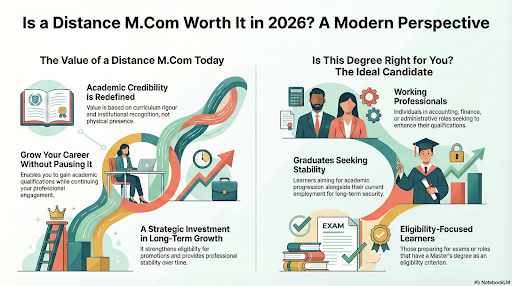
In 2026, academic credibility is increasingly assessed by curriculum rigour, institutional recognition, and learning outcomes—not merely by physical presence. Distance postgraduate commerce programmes that maintain structured syllabi, regulated assessments, and academic continuity continue to hold legitimacy within higher education frameworks.
Relevance and the 2026 Perspective
The relevance of any postgraduate degree must be assessed in the context of future skill demands and industry expectations. From a forward-looking standpoint, distance M.Com relevance in 2026 is shaped by how commerce roles themselves are evolving.
Financial reporting, compliance, taxation, corporate governance, and financial analysis now operate within digital ecosystems. Organisations seek professionals who understand both conceptual frameworks and applied systems. At the same time, regulatory complexity and accountability requirements have increased across sectors.
These shifts align closely with broader higher education trends in commerce, where postgraduate programmes are expected to strengthen analytical reasoning, financial interpretation, and regulatory awareness. The programs that focus on conceptual clarity and applied understanding remain relevant precisely because they build this foundational competence.
Career Scope, Growth, and Market Acceptance
Career outcomes in commerce are rarely linear. Progression depends on a combination of academic qualifications, professional exposure, and continuous skill development. In this context, the distance education impact on commerce careers is best understood as enabling sustained professional growth rather than immediate role transformation.
Graduates exploring distance M.Com opportunities in India typically engage in roles across accounting, finance operations, taxation support, compliance, banking services, education, and administrative functions. For working professionals, this program often strengthens eligibility for promotions, role transitions, or professional stability rather than serving as an entry-level differentiator.
The acceptance of M.Com Distance Education in the job market has also matured. Employers increasingly evaluate competence, experience, and role readiness alongside academic credentials. For roles where conceptual understanding and regulatory knowledge matter, a recognised degree continues to carry professional weight.
Skills, Learning Outcomes, and Student Development
The long-term value of a postgraduate degree lies not in its title but in what learners take away from it. The learning outcomes of distance M.Com extend beyond subject knowledge to include analytical discipline, financial interpretation, and structured problem-solving.
Commerce education inherently develops:
- Financial reasoning and numerical analysis
- Understanding of accounting standards and compliance
- Interpretation of economic and business data
- Structured decision-making within organisational contexts
Through systematic coursework and evaluation, distance M.Com skill development reinforces these competencies while allowing learners to contextualise them within their professional environments. This dual exposure—academic and practical—often strengthens learning retention and application.
The distance M.Com benefits for students are therefore cumulative rather than immediate. Learners gain academic progression without professional disruption, allowing them to integrate learning outcomes gradually into real-world practice.
The Broader Commerce Education Ecosystem
It is important to position this degree within the wider spectrum of postgraduate commerce education. Full-time, part-time, distance, and online modes each serve different learner profiles. Distance education, in particular, supports continuity for those who cannot pause professional or personal commitments.
The increasing emphasis on flexible learning in higher education reflects this reality. Flexibility here does not imply academic dilution; it reflects adaptability in delivery while preserving intellectual rigour. In commerce education, where professional application evolves alongside academic study, such flexibility often enhances learning relevance rather than reducing it.
If you want to understand this trend in context, our team can help.
Contact Us →Career Growth and Professional Continuity
The question, “Is Distance M.Com Worth It in 2026?” does not have a universal answer; however, it depends on the learner’s intent. For individuals seeking immediate job switches without relevant experience, expectations may need recalibration. For those aiming for long-term professional stability, academic progression, or eligibility-based growth, the M.Com degree continues to be meaningful.
Similarly, asking Is distance M.Com valuable? requires contextual evaluation. Its value lies in sustained relevance, academic credibility, and the ability to coexist with professional responsibilities—not in short-term outcomes alone.
For many, this integration answers the question How does Distance M.Com support career growth? It strengthens conceptual confidence, enhances role readiness, and improves long-term progression prospects without disrupting existing career trajectories.
Who Should Consider Distance M.Com in 2026?
This program is particularly suitable for:
- Working professionals in accounting, finance, or administrative roles
- Graduates seeking academic progression alongside employment
- Learners preparing for eligibility-based roles or examinations
- Individuals aiming for long-term stability rather than rapid transitions
Those seeking purely technical specialisations or immediate job placement may find other pathways more aligned with their goals.
Addressing Common Questions
Yes, for learners seeking academically credible postgraduate education alongside professional continuity, the degree remains relevant in 2026.
By enabling learners to build academic depth while continuing professional engagement, it supports gradual and sustainable progression.
Working professionals, career-stable learners, and those seeking recognised postgraduate commerce qualifications should consider this pathway.
The Future of Commerce Education
In 2026, the value of postgraduate education is defined by adaptability, relevance, and academic integrity. When pursued through a credible institutional framework, it aligns well with these priorities. It does not promise instant transformation—but it offers something more durable: continuity, depth, and long-term professional relevance.
For learners who understand education as a strategic investment rather than a quick outcome, Distance M.Com remains a grounded and meaningful choice within the evolving commerce education landscape.