Political developments today unfold faster than academic calendars. Electoral realignments, global power shifts, policy reforms, constitutional debates, and public governance challenges dominate daily discourse. From social media debates to legislative reforms, politics no longer feels distant or theoretical—it shapes economic opportunity, institutional trust, and civic life in real time.
Against this backdrop, political science is no longer only about studying the past. It has become a discipline for interpreting the present and preparing for the future. Understanding power structures, policy intent, governance mechanisms, and international relations now requires systematic academic grounding rather than surface-level opinion.
This is where the Master of Arts in Political Science finds renewed relevance—not as a legacy humanities degree, but as an analytical framework for navigating contemporary governance and political complexity.
- Political Science as a Discipline in the Current Global Context
- Understanding the Program
- Core Subjects and Areas: Why These Domains Still Matter Today
- Interpreting Power and Ideology
- Global Interdependence and Strategic Power
- Institutions, Federalism, and Governance
- Learning Across Systems
- MA Political Science Academic Structure
- Research, Methodology, and Governance Studies
- Research Methods in Political Science
- Public Administration and Governance Studies
- MA in Political Science Eligibility
- Learning Outcomes and Skills Developed
- Political Science and Understanding Governance Today
- Who Should Consider an MA in Political Science?
- Clarifying Common Questions
- A Closing Reflection: Political Science as Interpretive Power
Political Science as a Discipline in the Current Global Context
To understand what an MA in Political Science represents today, one must first recognise how the discipline itself has evolved. Political science is no longer confined to ideological debates or constitutional memorisation. It now intersects with economics, technology, sociology, public policy, international security, and administrative reform.
Contemporary politics is shaped by:
- Data-driven governance and digital policymaking
- Globalised economic interdependence
- Shifting democratic institutions
- International conflicts and diplomatic realignments
- Expanding role of civil society and public accountability
Studying political science today means engaging with structures of power, decision-making systems, and governance outcomes, rather than isolated political events. This shift defines the academic focus of MA Political Science in modern universities.
Understanding the Program
When asked what is MA Political Science, the most accurate answer is that it is a structured academic study of how societies govern themselves—formally and informally—across time and contexts.
A contemporary MA Political Science course overview typically emphasises:
- Theoretical foundations of political thought
- Institutional structures of governance
- Policy formulation and administrative systems
- Domestic and international political dynamics
The Master of Arts in Political Science is therefore less about preparing for a single profession and more about cultivating political literacy, analytical reasoning, and governance insight—skills increasingly relevant across public and private sectors.
Core Subjects and Areas: Why These Domains Still Matter Today
The strength of political science lies in its core areas, each of which has gained renewed importance in current affairs.
Interpreting Power and Ideology
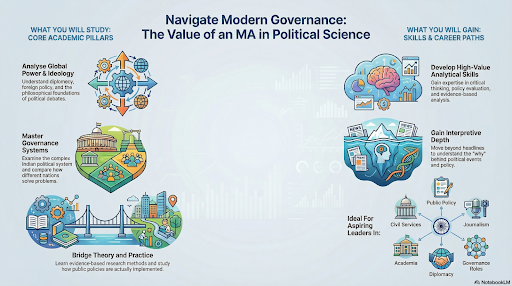
Political theory remains the backbone of political science education. Far from being abstract, it provides the conceptual tools to understand modern debates around democracy, rights, justice, authority, and legitimacy.
In an era of ideological polarisation, political theory helps learners:
- Distinguish between governance models and ideological frameworks
- Analyse political narratives critically
- Understand the philosophical foundations of constitutions and laws
This theoretical grounding is essential for interpreting contemporary political discourse with clarity rather than bias.
Global Interdependence and Strategic Power
Modern geopolitics has brought international relations to the centre of public attention. Trade wars, regional conflicts, climate diplomacy, and strategic alliances now affect domestic policy decisions directly.
International relations as a core area enables learners to:
- Understand global power structures and diplomacy
- Analyse foreign policy decisions
- Interpret international institutions and treaties
In a globally interconnected world, this knowledge extends far beyond academic interest and informs careers in policy research, media analysis, and strategic advisory roles.
Institutions, Federalism, and Governance
The Indian political system is among the most complex democratic frameworks globally. Federal relations, constitutional bodies, electoral mechanisms, and judicial oversight require deep academic engagement to be understood meaningfully.
This area of study equips learners to:
- Analyse constitutional processes
- Understand legislative and executive functioning
- Engage critically with public policy debates
For those interested in governance, civil services, or academic research, this domain remains foundational.
Learning Across Systems
Comparative politics encourages learners to move beyond national boundaries and examine how different political systems address similar challenges. Comparing democracies, authoritarian regimes, and hybrid governance models allows students to identify patterns, failures, and innovations in governance.
This comparative lens is particularly useful in:
- Policy evaluation
- Institutional reform studies
- International development research
In a globalised political environment, comparative analysis strengthens contextual understanding and policy adaptability.
MA Political Science Academic Structure
Together, these domains form the core of MA Political Science subjects, supported by electives and interdisciplinary papers depending on institutional design.
The core areas of MA Political Science are not static—they adapt to changing political realities while retaining conceptual continuity. Such alignment ensures that learners are not restricted to localised perspectives but gain exposure to nationally recognised academic standards.
While political science curricula vary across institutions, many Indian public universities follow broadly aligned academic frameworks. For instance, the CCSU MA Political Science syllabus, as followed by institutions like Chaudhary Charan Singh University, reflects this balance between classical theory and contemporary governance studies—ensuring academic continuity and national relevance.
Research, Methodology, and Governance Studies
A defining feature of postgraduate political science education is its emphasis on research and systematic inquiry.
Research Methods in Political Science
The research methods train learners to move from opinion to evidence-based analysis. This includes:
- Qualitative and quantitative research techniques
- Policy analysis frameworks
- Data interpretation and case study evaluation
These skills are essential for careers in research, academia, policy analysis, and governance advisory roles.
Public Administration and Governance Studies
Modern governance extends beyond elected representatives. Studying administration and governance examines how policies are implemented, institutions function, and public services are delivered.
This area bridges theory and practice by focusing on:
- Bureaucratic systems
- Administrative reforms
- Accountability mechanisms
In current governance discourse, administrative efficiency and institutional capacity are as critical as political ideology.
MA in Political Science Eligibility
Rather than viewing eligibility as a rigid checklist, admission into an MA Political Science reflects academic preparedness.
Typically, candidates who have completed an undergraduate degree in any discipline and demonstrated consistent academic engagement are considered suitable. Learners with a background in social sciences or related subjects may receive academic preference, while others are assessed on overall academic performance and subject familiarity.
This approach ensures that entrants possess both foundational knowledge and the ability to engage with advanced political analysis—rather than restricting the discipline to a narrow academic background.
Learning Outcomes and Skills Developed
The true value of political science education lies in its outcomes rather than its titles. The learning outcomes of the MA Political Science extend across intellectual, analytical, and applied dimensions. Graduates develop:
- Strong critical and interpretative abilities
- Policy analysis and evaluation skills
- Research literacy and methodological rigour
The analytical skills developed in political science enable learners to assess political developments with depth, coherence, and contextual understanding—skills applicable across governance, media, education, and organisational leadership.
Political Science and Understanding Governance Today
One of the most practical contributions of MA Political Science is its role in helping learners make sense of governance beyond headlines. Policies are not isolated announcements; they are outcomes of institutional processes, political negotiations, and administrative capacity.
By engaging with political science frameworks, learners gain:
- Clarity on decision-making processes
- Insight into policy consequences
- Ability to distinguish governance intent from implementation reality
This understanding is increasingly valuable in a world where political narratives often outpace substantive analysis.
Who Should Consider an MA in Political Science?
Political science is not for everyone—and that clarity strengthens its value.
An MA in Political Science is particularly suitable for:
- Aspirants of civil services and public policy roles
- Educators and academic researchers
- Journalists, analysts, and media professionals
- Individuals interested in governance, diplomacy, and public affairs
Those seeking purely technical or vocational outcomes may find other disciplines more aligned with their goals.
Stay informed about current intakes, see updates.
CCS University ODL admission →Clarifying Common Questions
It is a postgraduate academic programme focused on political theory, governance systems, policy analysis, and domestic and international political structures.
The scope spans education, research, governance, policy analysis, media, and roles requiring political and institutional understanding.
Core subjects include political theory, international relations, the Indian political system, comparative politics, research methodology, and governance studies.
It provides frameworks to analyse policy formulation, institutional functioning, administrative processes, and political accountability.
Learners interested in public affairs, governance, research, teaching, and analytical roles should consider this programme.
A Closing Reflection: Political Science as Interpretive Power
In a time when political information is abundant but understanding is scarce, political science offers something increasingly rare—interpretive depth. The Distance MA in Political Science is not merely a qualification; it is a disciplined way of thinking about power, policy, and public life.
For learners willing to engage deeply with ideas, institutions, and governance systems, political science remains one of the most intellectually relevant disciplines of the present and future.